Depok, 25 June 2025. Indonesia, as home to extraordinary global biodiversity, faces major challenges due to land-use change and forest fires. However, Prof. Dr. Rokhmatuloh, S.Si., M.Eng., remains optimistic about the positive trends in forest restoration thanks to policies such as social forestry and the Deforestation and forest Degradation (REDD+), which demonstrates the commitment of the government and the community.
He stated the importance of Indonesia’s forests as multifunctional ecosystems—not only as climate regulators and biodiversity hotspots, but also as abundant economic resources. The potential of timber and non-timber forest products is immense, ranging from leading export commodities to high-value products for indigenous communities. However, this potential can only be fully realized if forests are managed sustainably. This is where the vital role of remote sensing comes in, supporting evidence-based forest management (evidence-based forest management).
In the era of Industry 4.0, the integration of remote sensing with artificial intelligence (AI), machine learning (Machine Learning – ML), and cloud computing has become key. These advancements enable fast, automated, and accurate data analysis and facilitate the use of drones for high-resolution image acquisition in a flexible and cost-effective manner. Overall, remote sensing has become an essential foundation of modern forest management, supporting data-driven policymaking and increasing transparency in natural resource governance.
In addition, the use of big data and AI has revolutionized remote sensing data analysis in the forestry sector. The large and complex volumes of data from optical satellites, radar, drones, and LiDAR can be processed efficiently using advanced computing systems. AI’s advantages in automated analysis enhance the accuracy of forest mapping and real-time monitoring. Platforms cloud computing such as Google Earth Engine (GEE), which provides access to thousands of petabytes of satellite data, enable efficient cross-temporal and cross-regional analysis, supporting both the scientific community and policymakers.
Furthermore, the combination of big data and machine learning not only accelerates data processing but also enables predictive modeling. This greatly supports projection-based forestry planning, such as estimating carbon stocks, tree growth, and wildlife habitats. The application of Deep Learning (DL) in remote sensing data processing for forestry, especially with algorithms Convolutional Neural Network (CNN), is capable of performing land-cover classification, forest-change detection, and vegetation-species mapping with high accuracy.
Prof. Rokhmatuloh also highlighted more advanced DL applications, including automatic deforestation detection using data time-series and the use of U-Net to map forest boundaries and identify post-fire vegetation regeneration. Platforms like GEE further facilitate the integration of remote sensing big data with DL models, enabling large-scale analyses that support conservation and sustainable forest management in Indonesia.
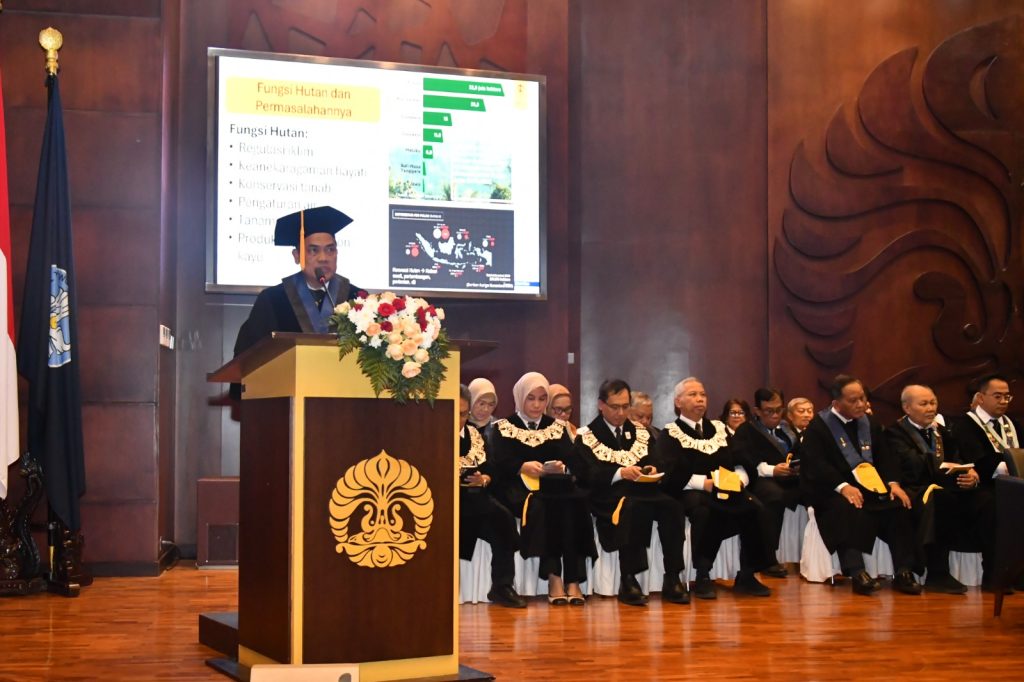
In his inauguration speech at Balai Sidang, UI Depok Campus, on Wednesday (25/6), Prof. Rokhmatuloh emphasized that the benefits of remote sensing in Indonesian forestry are not only as tools for monitoring and reporting, but also as important instruments for law enforcement, forestry planning, and climate-change mitigation. The use of big data and deep learning has opened a new paradigm in sustainable forest management, providing fast, adaptive, and highly precise analytical systems. This supports policymaking that real-time and predictive, which is crucial for sustainable forest management efforts in Indonesia. Before being inaugurated as the 33rd Professor of UI in 2025, Prof. Rokhmatuloh completed his undergraduate studies at the Department of Geography, Faculty of Mathematics and Natural Sciences (FMIPA) UI in 1996. He then successfully completed his master’s and doctoral degrees at Chiba University, Japan, in 2004 and 2007. Present at his inauguration ceremony were the Head of the Geospatial Information Agency, Prof. Dr. rer. nat. Muh Aris Marfai, S.Si., M.Sc.; the Vice Dean for Education, Teaching, and Student Affairs of the Faculty of Geography, UGM, Dr. Sigit Heru Murti B.S., S.Si., M.Si.; the Director of Human Resources of the Geospatial Information Agency, Dr. rer. nat. Sumaryono, M.Sc.; the President Director of Golden Energy Mines (Sinarmas Group), Dr. Ir. Hartana, S.H., M.H., M.M.; and Permanent Lecturer at UNHAN, Obstetrics and Gynecology Specialist at RSPAD Gatot Soebroto, Maj. Gen. TNI Dr. dr. Sutan Finekri Arifin A., Sp.OG., Subsp.K.FM., M.A.R.S., M.H.