Depok, December 15, 2022. The current use of fossil fuels is burdening CO2 emissions, thus contributing to global warming. New, renewable, environmentally friendly energy sources are needed to replace fossil fuels, as they have the disadvantage of a slow carbon cycle. Meanwhile, humans use vast amounts of energy to meet their daily needs. As a result, oil reserves ready for exploration are dwindling, as not all of the carbon emitted into the atmosphere has been returned to petroleum deposits.
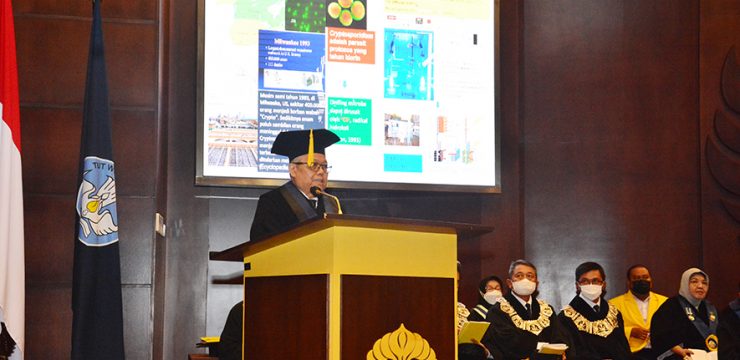
"Therefore, as a country rich in sunlight and many minerals, Indonesia is in a good position or momentum to contribute to solving the energy problem. With the help of the ideas of researchers and technology, it will be very possible to produce new energy that can replace the current energy we use and overcome the carbon cycle problem, by trying to shorten the cycle chain," said Prof. Dr. Jarnuzi Gunlazuardi during his inaugural speech as a professor in the field of Photo Electro Chemistry, Faculty of Mathematics and Natural Sciences, University of Indonesia (FMIPA UI), on Wednesday (14/12).
This system, said Prof. Jarnuzi, can in principle convert (fix) CO2 gas into methanol, or N2 gas into ammonia. Methanol and ammonia can be used as energy-producing fuels or as precursors to other compounds useful for life.
"In photoelectrochemical cell systems, we sometimes encounter inefficiency problems due to overpotential. To overcome this, we need an additional external power supply input. We propose to overcome this problem by developing a tandem system between solar cells and electrochemical cells. The solar cells used are Gratzel-type solar cells, namely Dyes Sensitize Solar Cell (DSSC), which are paired with photoelectrochemical cells (PEC), hence the tandem system is called tandem DSSC-PEC," he said.
He added that the DSSC-PEC tandem system or device developed with the aid of sunlight and an aqueous electrolyte medium can convert CO2 gas into methanol, nitrogen into ammonia, and produce hydrogen from the splitting of water. Hydrogen is an environmentally friendly renewable energy and is touted as a future fuel. Meanwhile, methanol and ammonia are not only fuels but also important precursors for conversion into chemicals for industry and agriculture.
The inauguration procession of the professors was led by the Chancellor of UI, Prof. Ari Kuncoro, SE, MA, Ph.D., at the Convention Hall, UI Campus, Depok, and broadcast virtually through the YouTube channels of the University of Indonesia and UI Television.
"I would like to thank you for your speech. It is very relevant to the energy transition, where we will decarbonize. So, we will shift from fossil fuels to new, renewable energy, and the skies will be bluer. I congratulate you on your inauguration as a Permanent Professor at the Faculty of Mathematics and Natural Sciences, University of Indonesia," said the UI Rector.
The inauguration procession of the professor was attended by Vice President of Pertamina Energy Institute, PT Pertamina (Persero), Dr.rer.nat Hery Haerudin; Senior Researcher, Center for Political Research (Conflict, Defense and Security) BRIN, Prof. Research. Dr. Hermawan Sulistyo, MA; Senior Researcher, Center for Research on Raw Materials for Medicine and Traditional Medicine, BRIN, Prof. Research. Dr. Muhammad Hanafi, MSc.; Senior Researcher of Chemical Research Center, BRIN, Prof. Dr. Ir. Anny Sulaswatty M.Eng; and Professor of FMIPA Halu Oleo University, Kendari, Prof. Dr. Muh. Nurdin, M.Sc..
Prof. Janurzi menjalani pendidikan sarjana di Departemen Kimia, Fakultas Matematika dan Ilmu Pengetahuan Alam, UI. Sejak lulus program sarjana di tahun 1984, ia memulai karir sebagai dosen Departemen Kimia, FMIPA UI. Kemudian, Prof. Janurzi melanjutkan pendidikan magister dan doktornya di bidang Environmental Chemistry, di Ehime University, Matsuyama, Japan, pada 1898-1993.
To date, Prof. Janurzi has published 40 international journal articles and 44 international proceedings journal articles. Some of the published scientific works include Comparative Study of Bismuth Ferrite Deposition Method on TiO2 Nanotube and Performance of Hydrogen Evolution in a Photoelectrochemical Dye-Sensitized Solar Cell Tandem System (2022); Core-shell copper-gold nanoparticles modified at the boron-doped diamond electrode for oxygen sensors (2022); Electrochemical Preparation of Highly Oriented Microporous Structure Nickel Oxide Films as Promising Electrodes in Urea Oxidation (2022); Magnetically Separable Fe3O4/SiO2/TiO2 Photocatalyst Composites Prepared through Hetero Agglomeration for the Photocatalytic Degradation of Paraquat (2021); and NickelCobalt Modified Boron-Doped Diamond as an Electrode for a Urea/H2O2 Fuel Cell (2021).